PIPL

PIPL

Monday, September 10, 2012

Buff-breasted Sandpipers

This week I will be highlighting a few more of the tremendous shorebirds we have recorded during our International Shorebird Surveys or general monitoring of important shorebird staging and feeding areas. These may be odd to see in our state or rare in general because they are an imperiled species. One of the latter category is the Buff-breasted Sandpiper, a distinctive and unique shorebird that Patrick Comins photographed wonderfully below.


The Buff-breasted Sandpiper was hunted by the thousands a little over 100 years ago. It is now classified as globally near-threatened by BirdLife International. The total global population is approximated at only 15,000 individuals according to the Canadian Wildlife Service.


Its continued decline is linked somewhat to breeding habitat contamination, wintering and stopover site degradation, and the loss of very specific features that it requires (short grasslands, meadows, flooded fields, and other agriculture-related land). Its migration pathway takes it primarily through the central U.S. from the breeding grounds in the arctic tundra to South America, but Connecticut picks up a bird or two here or there that stray too far to the east coast each fall season.


So far in 2012, the species has been seen at a grand total of two (very expected) Connecticut locations - Rocky Hill Meadows, where the above photos are from, and Sikorsky Airport in Stratford, with another possible couple flying by Stratford Point. The airport only held two birds for one day, but Rocky Hill Meadows has held them on several days hosting up to four birds as noted there yesterday. Even though we as a state may be off course for the species, having such habitat readily available greatly aids the handful of birds that pass through each year on their journey. This is especially important when perhaps 15 individuals constitute 1/1000 of the entire population.


Audubon Alliance for Coastal Waterbirds, Audubon Connecticut and the Connecticut Audubon Society partnering to improve conditions for coastal waterbirds in Connecticut.

Friday, September 7, 2012

Sprague's Pipit? Horned Lark

Earlier this week there was quite an exciting commotion over a bird at Rocky Hill Meadows as tens of birders likely raced to their cars to see what appeared to be a Sprague's Pipit. After being found in the early morning, those who got to the site throughout the morning had also temporarily fallen prey to a vexing identification. This "pipit" was able to deceive many very experienced and knowledgeable birders...for a little while. It did not take too long for those on hand to determine that they were looking at a juvenile Horned Lark. Here are some photos taken by Patrick Comins.


The bird looks is going through a molt and still is rather "messy", with the streaky breast rather blotchy instead of finely streaked, and a dark patch under the eyes instead of being all pale. The bill is too large and the legs are too dark, plus it has that white edging on the tail as Horned Larks do. The pattern of the white coverts with some white spots and an overall drab (even with the dark photo) brown color stands in contrast to what should be a warmer and maybe more buffy brown for a Sprague's. This is very easy to sit here and write now, staring at photos and a couple books and having thought about it, rather than anxiously tracking it in the field hoping for a life bird. The problem is that we only exceptionally rarely get to see a Horned Lark that looks like this in our state, and I am sure 99% of us would not immediately think it was what it actually was initially.

Before you ask me why I am writing about this in the Audubon Alliance for Coastal Waterbirds blog I should mention that Horned Lark is actually one of our target species. Most people in Connecticut think of them as a wintering bird, seen in sizable flocks feeding in open areas, sometimes mixed in with Snow Buntings. However, they do breed in Connecticut, and this breeding population is in fact a state-listed endangered species! They also nest in short grass and barren country, utilizing locations like airports, beaches, and associated dunes. One could expect them to be able to nest near a location like Rocky Hill Meadows, the Coastal Center at Milford Point or Stratford Point, or any of the large airports such as Sikorsky in Stratford or of course Bradley in Windsor Locks.

Check out this very cool fledged Horned Lark that Twan Leenders spotted at Stratford Point on one hot July day in 2009 on the Connecticut Audubon Society blog. We will be watching for Horned Larks year-round and hoping to see more of them in the summer months in the future.


Audubon Alliance for Coastal Waterbirds, Audubon Connecticut and the Connecticut Audubon Society partnering to improve conditions for coastal waterbirds in Connecticut.

Wednesday, September 5, 2012

Fencing removal and requesting data

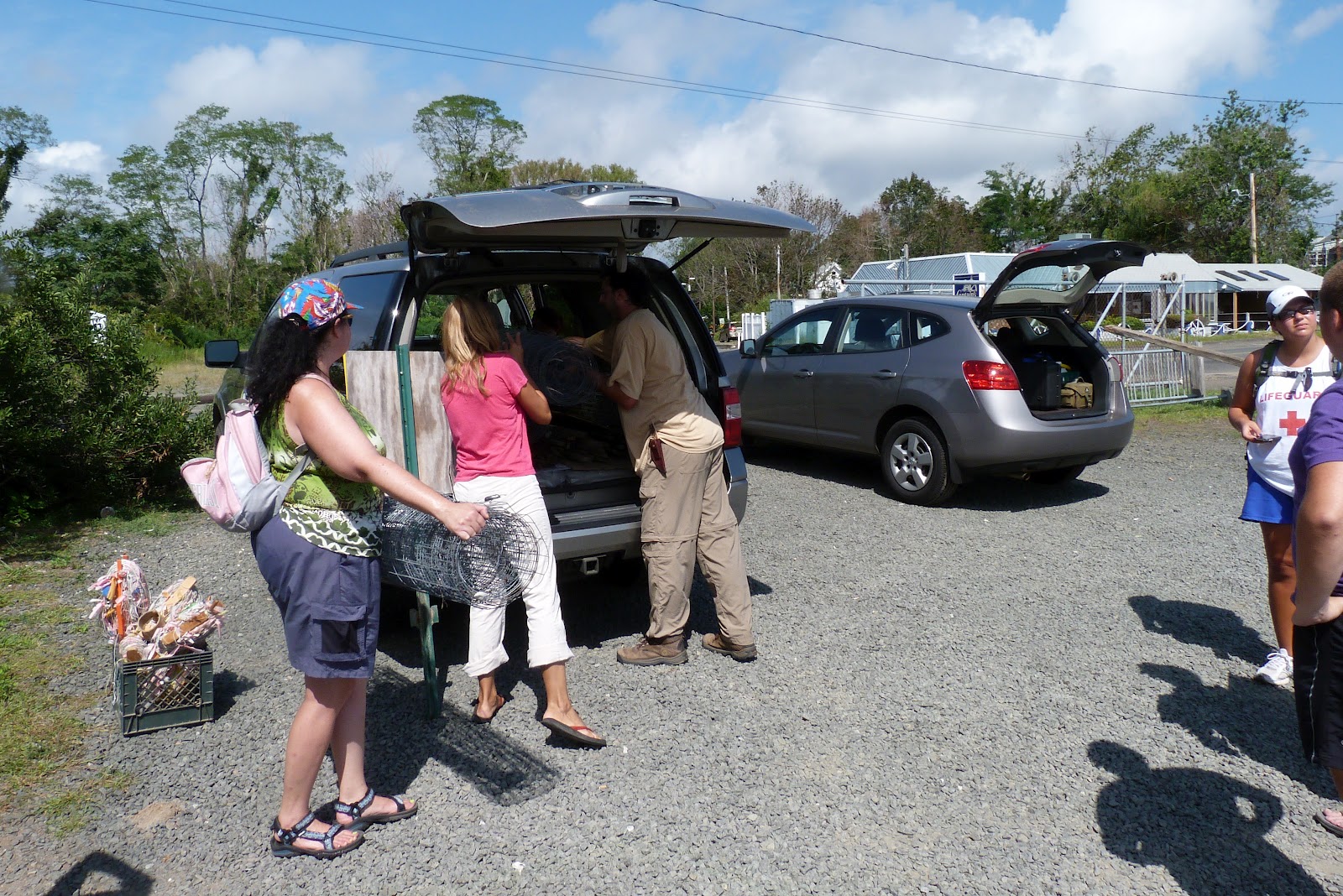
The Audubon Alliance for Coastal Waterbirds and a bunch of ever-intrepid volunteers recently joined the Connecticut Department of Energy and Environmental Protection in removing the string fencing and Piping Plover exclosures from Morse Point in West Haven. We also assisted CT DEEP and The Nature Conservancy with the effort at Griswold Point in Old Lyme. Both of these removals came late in the season for a very good reason as many Least Terns nested at both sites, and some of our waterbirds cleared out only a few days before. We seem to have had a wonderful year for Least Terns in particular.

Here are some of action shots from the work parties from Audubon Connecticut Director of Bird Conservation Patrick Comins and Connecticut Audubon Society Conservation Technician Scott Kruitbosch:

We had both young children and teens helping us out often this year, the next generation!

A beautiful day at Sandy and Morse Points

Packing it up for the season

Before we know it we will be taking the gear back out of the vehicles in 2013

Semipalmated Sandpipers at Griswold Point

Loads of Monarchs in Old Lyme! We watched for butterflies while working and saw some cool coastal vagrants like Cloudless Sulphurs while in West Haven

Fording the channel at Griswold Point

Michael Brooks carrying a bunch

Followed by Sean Graesser doing the same

A beautiful day in Old Lyme as well

The journey back

It certainly does not seem like six months has passed to us, but in another six months we will be well underway with monitoring the first-arriving coastal waterbirds, with Piping Plovers and American Oystercatchers filtering in to beaches everywhere. Until that time we have a tremendous amount of work to do, with two more months in the field monitoring some of these species as they depart plus conducting International Shorebird Surveys before report writing, presentations, analysis, mapping, number-crunching, and more, all while planning for 2013!

If you have yet to submit some of your data or information from the 2012 field season please email it to us at ctwaterbirds@gmail.com as soon as you can. Additionally, if you would like to submit the hours you participated in the project you can do so as well. If you regularly submitted all of your surveys we can calculate this ourselves, but if you spent extra time on the beach or did not send us all of your data, we would like this hourly total as well please, thank you!


Audubon Alliance for Coastal Waterbirds, Audubon Connecticut and the Connecticut Audubon Society partnering to improve conditions for coastal waterbirds in Connecticut.

Monday, September 3, 2012

Audubon Alliance for Coastal Waterbirds update #25

This is the twenty-fifth and final weekly update by the Audubon Alliance for Coastal Waterbirds (AAfCW) for the 2012 season. It includes reports of Piping Plover, American Oystercatcher, Least Tern, and Common Tern received from 12:00 p.m. on August 27 through 7:00 p.m. on September 3 with sightings of birds spanning August 27 through September 3 by our staff and volunteers.

Survey and monitoring updates:

Piping Plover
Volunteer and staff surveys:
1 juvenile at Harkness Memorial State Park on 8/29

American Oystercatcher
Volunteer and staff surveys:
2 pairs at Sandy/Morse Points on 8/27
1 pair at West Haven on 8/27
7 adults at Bay Beach on 8/27
2 pairs at Menunketesuck Island on 8/27
1 adult at Menunketesuck Island on 8/28
1 pair at Milford Point on 8/28
2 pairs, 1 juvenile at Sandy/Morse Points on 8/29
2 pairs at Milford Point on 8/29
25 adults at Stonington Point on 8/29
2 adults at Ram Island on 8/29
2 pairs at Vincent Island on 8/29
1 pair at Greenway Island on 8/29
1 adult at Bluff Point on 8/30
2 pairs, 2 juveniles at Sandy/Morse Points on 8/30
1 pair, 1 adult at Milford Point on 8/30
2 pairs, 1 juvenile at Sandy/Morse Points on 8/31
2 pairs, 1 juvenile at Milford Point on 8/31
2 pairs, 2 juveniles at Sandy/Morse Points on 9/1
1 pair, 1 adult at Stratford Point on 9/2

Least Tern
Volunteer and staff surveys:
1 adult, 2 juveniles at Bluff Point on 8/27
1 adult, 1 juvenile at Long Beach on 8/28
1 adult, 2 juveniles at Griswold Point on 8/29
1 adult, 1 juvenile at Griswold Point on 8/30

Common Tern
Volunteer and staff surveys:
21 adults, 10 juveniles at Harkness Memorial State Park on 8/29
500 adults/juveniles at Stratford Point on 8/29
9 adults at Harkness Memorial State Park on 8/29
4 adults at Harkness Memorial State Park on 8/30
50 adults/juveniles at Sandy/Morse Points on 8/30
16 adults/juveniles at Sandy/Morse Points on 8/31
75 adults/juveniles at Milford Point on 8/31
1 adult at Sandy/Morse Points on 9/1
900 adults/juveniles at Stratford Point on 9/1
600 adults/juveniles at Stratford Point on 9/2
120 adults/juveniles at Stratford Point on 9/3

This concludes update #25 and the weekly regular season updates through 9/3/12 as of 7:00 p.m.


Audubon Alliance for Coastal Waterbirds, Audubon Connecticut and the Connecticut Audubon Society partnering to improve conditions for coastal waterbirds in Connecticut.

Sunday, September 2, 2012

Bluff Point fencing removal

We have one more fencing removal date set by CT DEEP for Bluff Point, and the Audubon Alliance for Coastal Waterbirds would appreciate any volunteers who could help us out. The plan is to meet at:

Thursday, September 6th at 10AM

We can meet in the parking area near the main gate. Given that many people will be making a long trip to the site, the 10AM start time is approximate. CT DEEP will have a vehicle to shuttle people from this parking area down to the beach. The string has already been removed, and all that remains is heavy lifting, so if you plan on joining us please be aware of the physical nature of the work.

Please email us at ctwaterbirds@gmail.com if you can join us, thank you!


Audubon Alliance for Coastal Waterbirds, Audubon Connecticut and the Connecticut Audubon Society partnering to improve conditions for coastal waterbirds in Connecticut.